
Study Finds 51% of Americans Have Had Their Identities Stolen
Identity theft is not a new threat. Since the mid-20th century, Americans have been protecting themselves against criminals stealing their personal information to commit fraud.
What is new is the technology being used to access this information. While identity theft used to require the stealing of actual physical objects like driver’s licenses or social security cards, these days it’s much more likely for victims to run into an AI-generated phishing text or fake call from the government.
To find out more about how Americans are dealing with identity theft in the age of AI, we conducted a survey of over 1,000 people. It turns out, it’s not just older Americans who are at risk as these scams become more sophisticated.
54% of Identity Theft Victims Lost Money, Averaging $2,800+
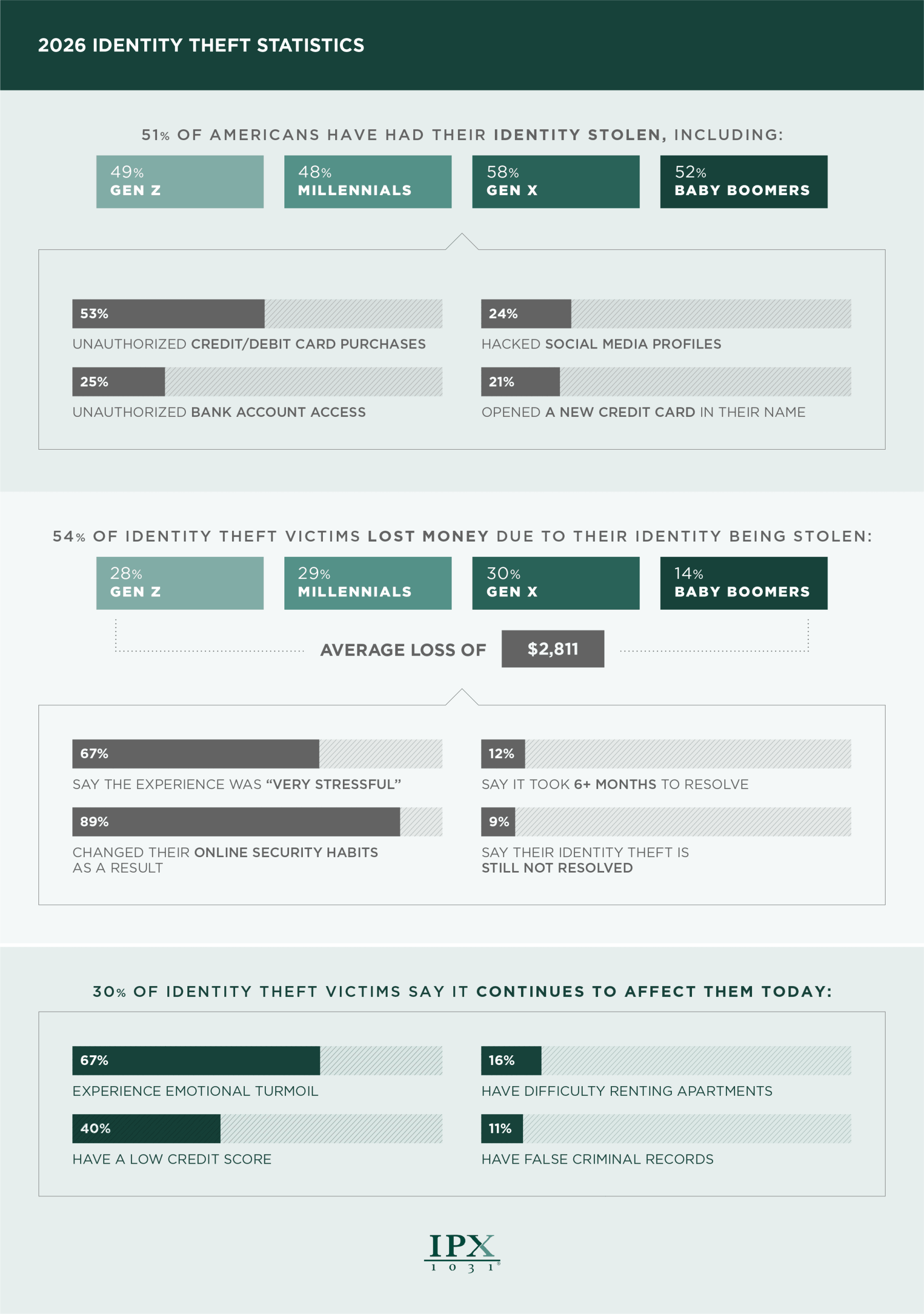
Just over half of Americans surveyed (51%) say that they have experienced identity theft. Despite the stereotype that older people are more likely to fall for these types of scams, the data shows a close generational breakdown. More than half (52%) of Baby Boomers have had their identity stolen, 58% of Gen X, 48% of Millennials, and 49% of Gen Z.
The most common types of identity theft reported by respondents include:
- Unauthorized credit/debit card purchases – 53%
- Unauthorized bank account access – 25%
- Hacked social media profiles – 24%
- A credit card opened in their name – 21%
- Unauthorized access to another online account – 20%
In fact, 54% of those who have experienced identity theft say they lost money as a result, with an average loss of $2,811. Baby Boomers were actually the smallest group to report losing money to identity theft at 14%, followed by Gen Z at 28%, Millennials at 29%, and Gen X at 30%.
If you are a victim of identity theft, how long does it take to resolve the issue? Answers were widespread, with 26% reporting less than a week to resolve the issue, 19% two weeks, 15% one month, 9% two months, 10% three to six months, and 12% six months or longer. 9% even reported that their identity theft issue is still not resolved today.
30% of Identity Theft Victims Are Still Affected Today
Having your identity stolen can be a harrowing experience with long-lasting consequences. More than 2 in 3 (67%) identity theft victims say their experience was “very stressful,” and 89% changed their online security habits as a result.
Additionally, nearly 1 in 3 victims (30%) say they continue to struggle today because of their experience, with issues including:
- Emotional turmoil – 67%
- Low credit score – 40%
- Difficulty renting apartments – 16%
- False criminal records – 11%
95% of Americans Are Concerned About AI and Identity Theft
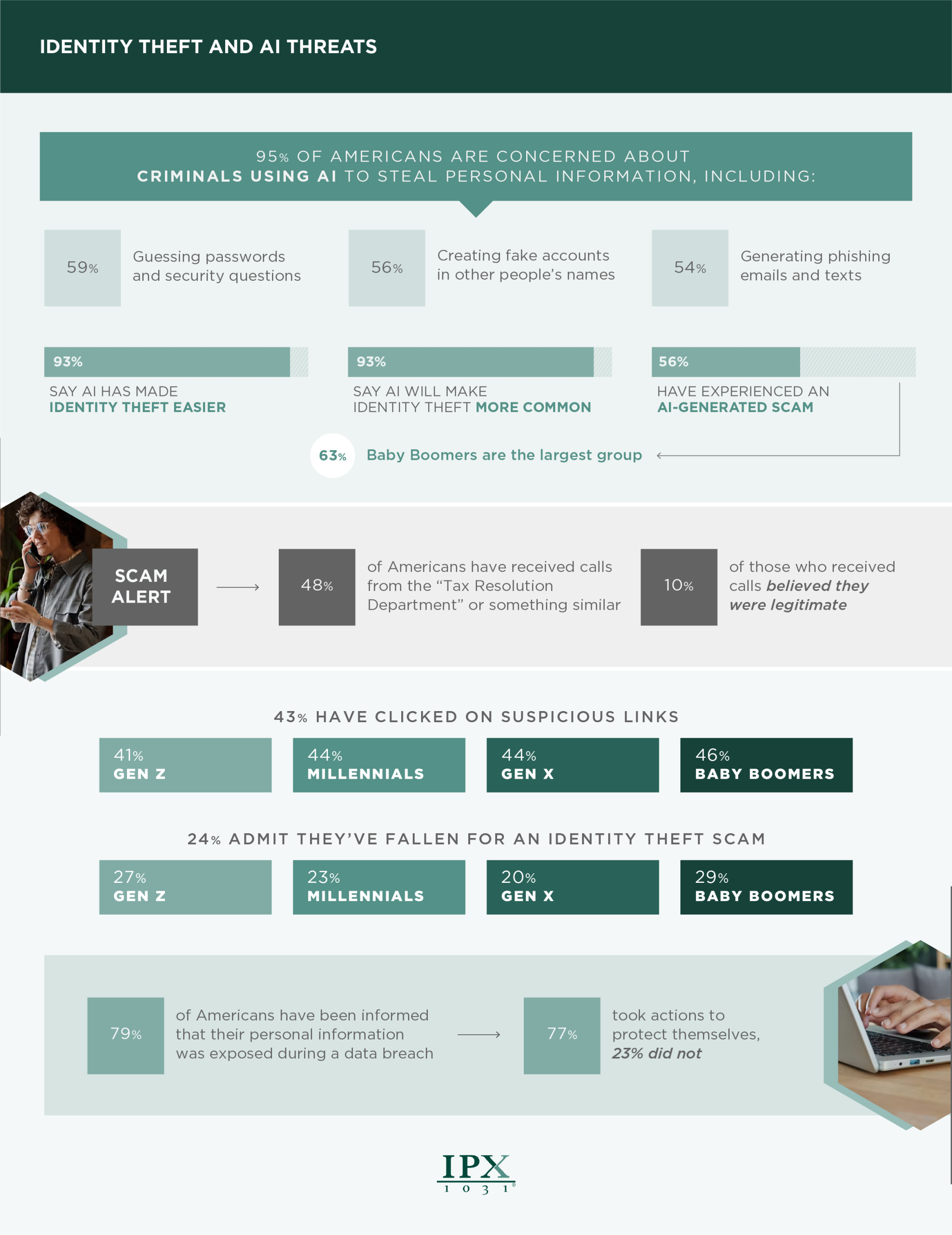
More than 9 in 10 respondents (95%) say they are concerned that criminals could use AI to steal their personal information. The most worrying threats include using AI to guess passwords or security questions (59%), using AI to create fake accounts in someone else’s name (56%), and using AI to generate phishing emails and texts (54%).
The majority (93%) believe that AI has already made identity theft easier, and 93% also say that AI will make identity theft more common over the next five years. Additionally, 56% of respondents have personally experienced an AI-generated scam. Baby Boomers are the most likely group to have experienced an AI scam, at 63%.
Nearly half, 48%, say they have specifically experienced a fake call from the “Tax Resolution Department” or something similar. Worryingly, 10% of those who have received these calls believed they were legitimate.
Americans View Data Breaches as the Most Pressing Concern
Despite the overwhelming concerns over AI’s effect on identity theft scams, the majority of respondents view data breaches as the more pressing issue. When asked to select what they believe is the biggest risk to personal information, 46% said data breaches, just 9% said AI scams, 7% said public wifi, and another 7% said phishing emails or texts.
Additionally, nearly 8 in 10 (79%) say they have been informed by a company or government agency that their information has been exposed by a data breach. Of them, only 77% say they took actions to protect themselves.
More Than Half of Americans Use the Same Password for Multiple Accounts
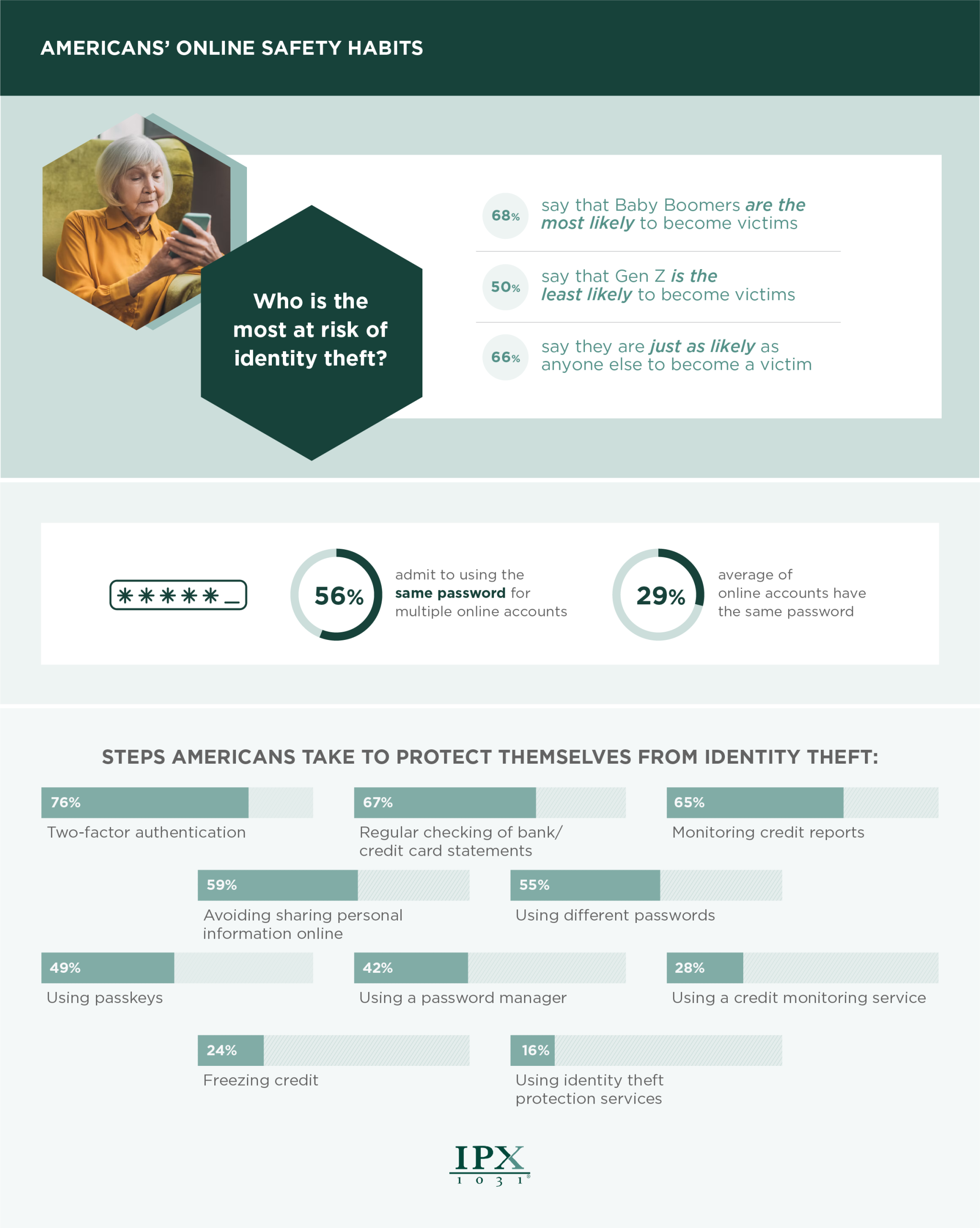
One of the easiest online safety measures one can take is to generate unique passwords for each account. However, 56% of respondents admit they use the same password for multiple online accounts, with an average of 29% of accounts sharing the same password.
Additionally, 24% say they don’t bother with two-factor authentication, 37% don’t regularly check their bank or credit card statements, and 35% don’t monitor their credit reports. Almost a quarter (24%) of Americans have fallen for an identity theft scam, including 29% of Baby Boomers, 20% of Gen X, 23% of Millennials, and 27% of Gen Z.
A surprisingly high percentage of respondents also admit to clicking on suspicious links, perhaps indicating how sophisticated these scams have gotten. Baby Boomers are the most likely to fall for suspicious links at 46%, but the other generations follow close behind, with 44% of Gen X, 44% of Millennials, and 41% of Gen Z.
Steps respondents are taking to protect themselves from identity theft include:
- Avoiding sharing personal information online – 59%
- Using different passwords – 55%
- Using passkeys – 49%
- Using a password manager – 42%
- Using a credit monitoring services – 28%
- Freezing credit – 24%
- Using an identity theft protection service – 16%
Identity Theft and Generational Stereotypes
Although the data show that people of all generations are falling victim to identity theft, there is a prevailing belief that older people, who are typically less skilled with modern technology, are more at risk. Nearly 7 in 10 (68%) respondents say that Baby Boomers are the most likely generation to become victims of identity theft, and 50% say Gen Z is the least likely.
Perhaps most interestingly, two-thirds (66%) of respondents believe they themselves are just as likely as the average American to become a victim of identity theft.
Investment Property Exchange Services, Inc (IPX1031) is the nation’s largest and most secure 1031 Qualified Intermediary (QI). If you are considering a Tax Deferred 1031 Exchange for your investment property, it’s critical that the funds from your sale are protected. IPX1031 has the financial assurances, security and expertise essentials to protect your funds and provide answers and guidance throughout the exchange process.
Methodology and Fair Use
In September 2026, we conducted a survey of 1,002 Americans about their experiences with and opinions of identity theft. Among respondents, 50% identified as women and 49% as men. Respondents ranged in age from 18-80 with an average age of 41.
For media inquiries, contact media@digitalthirdcoast.net. When using this data, please cite it correctly by linking to this study and crediting IPX1031.
Read More
Fraud Prevention in 1031 Exchanges: Keeping Your Funds Safe During Your 1031 Exchange
Fraud in America: A 2025 Report on Scam Hotspots and Consumer Losses
Safeguarding Your 1031 Exchange Transactions: Navigating Cyber Risks in Real Estate
American Fraud and Identity Theft Statistics 2024
Americans’ Experiences With Fraud and ID Theft
America’s Fraud and Identity Theft Reports by State 2023
Your 1031 Funds Are Safe
Simple Steps to Boost Your CyberSecurity
Safety & Security for Exchangers
Take Steps to Combat 1031 Cyber Fraud
1031 Exchange and Defer? Or Sell and Pay Taxes?
