
1031 Exchange Guide
1031 Exchanges & FinCEN: What 1031 Exchange Investors Need to Know
What the New Financial Crimes Enforcement Network (FinCEN) Rules Mean for Your 1031 Exchange
Beginning March 1, 2026, FinCEN’s Residential Real Estate Reporting Requirements apply nationwide. These rules are designed to increase transparency in certain all-cash residential real estate transactions.
Does FinCEN Apply to You?
Reporting applies if you are acquiring:
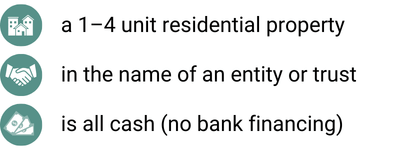
If all three apply, the Settlement Agent may be required to collect and report certain information.
Are There Additional Forms?
Generally, you do NOT need to complete additional FinCEN forms directly through IPX1031. IPX1031 will coordinate with your Settlement Agent regarding any requests.
How This Affects Your 1031 Exchange
FinCEN has no impact on your 1031 Exchange.
FinCEN may require additional reporting:
Delayed 1031 Exchange – Replacement Property
If you are purchasing Replacement Property to complete a 1031 Exchange:
- Funds are disbursed from the Qualified Intermediary to the Settlement Agent.
Under FinCEN guidance these disbursements may be reported by the Settlement Agent.
Reverse or Build-to-Suit Exchanges
- Transfers to the Exchange Accommodation Titleholder (EAT) are exempt.
- Transfers from IPX1031’s Exchange Accommodation Titleholder (EAT) may be reportable.
Recent Posts
PDF Downloads
Exchanger
Click to Download
Industry Partners
Click to Download
FAQs
Click to Download
FinCEN Frequently Asked Questions
What is the new FinCEN reporting rule?
Settlement agents must report non-financed residential real estate transfers to FinCEN when the buyer is an entity or trust. Beginning March 1, 2026, transactions covered by this rule must be reported.
What is FinCEN?
The Financial Crimes Enforcement Network (FinCEN) is a U.S. Department of Treasury bureau established in 1990 with a mission to “safeguard the financial system from illicit activity” by collecting and analyzing financial transactions.
What transactions must be reported?
- The property is residential real estate (including condos, townhomes, entire apartment buildings designed for 1–4 families, co-ops, and vacant land intended for 1–4 family structures)
- The transfer is non-financed (e.g., all-cash) or where the lender does not have an anti-money laundering (AML) program and an obligation to file SARs
- The buyer is a legal entity or trust
- No exemption applies
Who is responsible for filing?
The closing or settlement agent is the primary person responsible for filing the report. FinCEN has established a reporting cascade for who is responsible for reporting if the settlement agent is not involved in a transaction. The cascade is as follows:
- Settlement agent
- Preparer of the closing or settling statement
- Deed filer
- Underwriter of an owner’s title insurance policy
- Person disbursing the greatest amount of funds in connection to the transfer
- Person providing an evaluation of the title status
- Person preparing the deed or legal instrument of ownership transfer, including the stock certificate
How does this new rule affect real estate agents, buyers, and sellers?
Additional information from buyers and sellers must be collected for covered transactions. Failure to comply can result in civil and criminal penalties, including imprisonment. Agents must be proactive to avoid delays.
What are the exemptions to the reporting rule?
A transfer may be exempt:
- Due to death, divorce, or bankruptcy
- 1031 reverse exchanges
- Specific, highly regulated trusts and entities
- Transactions where the lender has an Anti-Money Laundering (AML) program and an obligation to file Suspicious Activity Reports (SARs) and the lender is securing a lien against the property
*Exemptions are very specific and customers may need to consult with their counsel to ensure exemptions are applicable.
What do sellers need to know?
Limited information about the sellers will have to be included in the report filed at closing.
Where can I learn more about the new RRE?
Visit the FinCEN website: https://www.fincen.gov/rre or contact us with any questions.
