
Smart Tips For Financial Growth

Key Takeaways
- Time is Money: Start saving and investing early. To help save money, set up automatic transfers from your checking account to your savings and investment accounts on payday. This ensures consistent saving and avoids the temptation to spend.
- Budget Like a Pro: Track, analyze, and adjust. Use budgeting apps or strategies like the 50/30/20 rule to track your income and expenses for a month and identify areas where you can cut back.
- Lifelong Learning: Continuously educate yourself on finances. Explore formal classes, online resources, or self-study to understand investments, taxes, and market trends and help build personal wealth.
- Advanced Advice: Diversify your income streams. Research potential real estate opportunities or rental properties to generate passive income. Side hustles can also be a great way to generate additional income.
Core Tips for Wealth Building
Building wealth begins with several key principles: budgeting, investing, debt management, and setting goals. Effective budgeting ensures you manage your money wisely, while strategic investing can grow your assets over time. Debt management helps keep debt under control and lowers it over time. Additionally, setting goals will assist you in meeting milestones along the way. Understanding your net worth is also key to building wealth. Net worth is the value of the assets a person owns minus any debt they owe.
Starting Early
The importance of starting early cannot be overstated. When you begin saving, managing, and investing your money at a young age, it allows your money more time to earn compound interest. Compound interest is when you earn interest on the money you’ve saved and on the interest you’ve earned along the way.
Recent data from the Federal Reserve Bank of New York finds for individuals 39 and younger, wealth increased by 80% from 2019-2023. In contrast, it grew by 10% among those aged 40-54 and by 30% for those 55 and over
If you did not start saving early, do not be discouraged. The second-best time to start is today. No matter when you start the wealth building process, it’s important to be consistent and disciplined in your practices. Regular contributions to your savings and investment accounts can accumulate over time and lead to further wealth creation.
Living Below Your Means
Living below your means is an element of wealth building that involves spending less than you earn. By consistently doing this, you can create a surplus of income that can be saved or invested for future growth. In order to live below your means, it’s essential to budget and make a conscious effort to differentiate between needs and wants. When you live below your means, you reduce the risk of accumulating debt, which also leads to overall improved financial health.
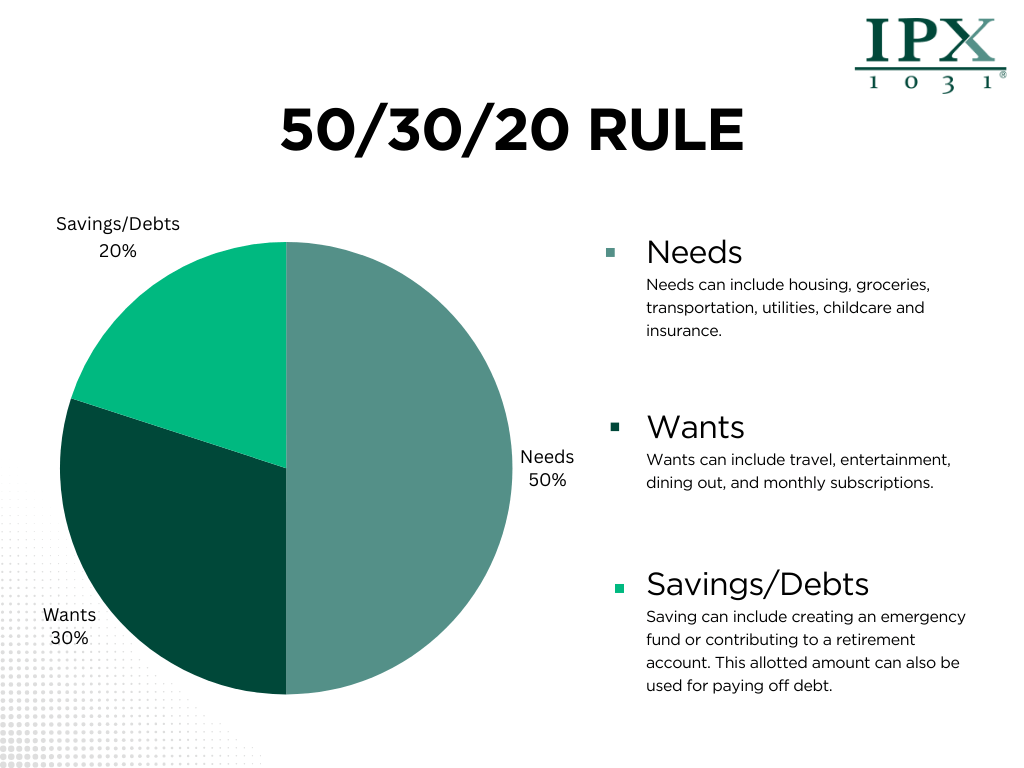
A widely accepted budgeting guide is the 50/30/20 rule. The 50/30/20 rule helps organize monthly spending into needs, wants, and goals. It recommends putting 50% of your money toward needs, 30% toward wants, and 20% toward savings or debt payments. By limiting the 30% of wants and putting more toward savings, you can work toward living below your means. There are many readily available personal budgeting templates and tools online to help you get started today.
The Importance of Saving Money
Saving money is a key component of financial health and wealth building. Establishing a habit of saving ensures you not only have funds for day-to-day expenses, but for emergencies, large purchases, and investment opportunities.
High Yield Savings Accounts
One effective way to maximize savings benefits is by utilizing high-yield savings accounts. These accounts offer higher interest rates compared to traditional savings accounts, allowing your money to grow more quickly, while still providing easy access to your funds. For example, high yield savings accounts can offer 4-5% APY (annual percentage yield), compared to the national average savings account rate of 0.45%, according to the Federal Deposit Insurance Corporation (FDIC).
Investing
Investing is a powerful tool for building wealth and achieving financial independence. There are many ways to invest and there isn’t one correct way or solution. Below we’ve outlined several different ways you can begin your investment journey:
Maximize Retirement Accounts
One of the most effective ways to start investing is to maximize your retirement accounts like 401(k)s and IRAs. A 401(k) is a retirement account offered by many employers. An IRA is a personal savings account. Both of these accounts offer tax advantages that can boost your savings over time through certain benefits including tax deferrals or employer matching contributions.
High Yield Savings Accounts
One effective way to maximize savings benefits is by utilizing high-yield savings accounts. These accounts offer higher interest rates compared to traditional s
Diversification, Stocks & Bonds
Diversification is a key principle in investing, helping to lower risk while maximizing potential returns. This means creating an investment portfolio with different types of assets. Stocks, for example, offer high growth potential but come with higher volatility. Balancing your portfolio with bonds, which are typically more stable and provide regular interest income, can help reduce the risk of market volatility.
Index funds are also a great way to diversify your investments. Index funds are a type of investment that tracks the performance of a market index, aiming to mimic the performance of a specific index. They typically have low expense ratios because they are passively managed, rather than actively managed by humans. An index fund may be a good choice for some as they are typically less volatile than individual stocks, and tend to provide more stable returns over the long term. This way you’re able to diversify your investments without having to constantly be trading or watching the market.
Exchange-Traded Funds (ETFs)
Exchange-traded funds (ETFs) are a collection of securities that you can buy and sell on a stock exchange. They can contain investments like stocks, bonds, commodities or currencies. ETFs are an efficient way to diversify across different sectors.
Real Estate & 1031 Exchanges
Real estate is another investment option that may appeal to you. Real estate investing includes rental properties. Utilizing strategies like 1031 Exchanges can help defer capital gains taxes when you sell a property and reinvest in another, maximizing your returns.
Delaware Statutory Trusts (DSTs)
Delaware Statutory Trusts (DSTs) are investment trusts that hold one or more pieces of real property in which investors can purchase an ownership interest. Multiple investors may each have a fractional ownership interest in the property held by that trust. For example, a DST may consist of a portfolio of apartment buildings, drugstores , office buildings, or healthcare facilities. DSTs (if structured properly) are considered to be direct investments in real estate and are eligible for 1031 tax deferrals.
Real Estate Investment Trusts (REITs)
Real Estate Investment Trusts (REITs) are companies that own and operate income-producing real estate. REITs are a way to invest in real estate without actually having to buy and manage the properties yourself. REITs can own a variety of properties, including apartment buildings, office buildings, shopping malls, warehouses, or hotels. REITs trade on stock exchanges, so an investor can buy shares of a REIT just like they would buy shares of a stock.
Long-Term Investing
Long-term investing focuses on holding investments for extended periods, capitalizing on the growth potential over time. Doing this can help reduce the impact of market volatility and allow for the benefits of compound interest.
Historically, the S&P 500, a broad index of the U.S. stock market, has delivered an average annual return of around 10%. This means by staying invested over the long term, investors can ride out market ups and downs and potentially achieve significant returns.
Managing Spending
Effectively managing spending is crucial for maintaining financial stability. This involves tracking expenses, creating and sticking to a budget, and making smart purchase decisions. By understanding where your money goes each month, you can identify areas where you can cut back or eliminate unnecessary expenses. Additionally, setting spending limits and avoiding impulse purchases can help prevent overspending.
Debt Management
If you have debt, it’s important to work toward getting it under control and eventually paid off for your overall financial health.
Paying off High-Interest Debt
High-interest debt, like credit card balances, can become a significant financial burden. By paying off these debts, you can reduce the amount of interest you pay over time and free up more of your income for saving and investing.
Using Debt to Build Wealth
There are ways you can strategically use debt to build wealth. As an example, using a low-interest debt like a mortgage or business loan, to invest in assets that appreciate over time can potentially lead to higher returns compared to the cost of borrowing. This approach requires careful consideration of risks and rewards, as well as a solid plan for managing debt payments responsibly.
You can also use debt to help build wealth through margin investing, exchanged traded funds, hedge funds, short selling, and forex trading. These investment strategies involve leverage (using borrowed money to increase your return). For example, margin investing is when you borrow money from your broker to buy a stock. By doing this, if the stock price goes up, you profit more than you would have by just using your own funds. However, if the price goes down, your losses are amplified. Leveraged ETFs aim to multiply the gains (or losses) of an underlying index. They can help magnify profits, but it should be noted they can also amplify losses. Leveraged ETFs can be attractive to people looking to capitalize on short-term market movements, especially if they believe the market will move sharply in a particular direction. With any investment, there is risk involved, so it is best to research and learn more about each strategy before investing.
Creating an Emergency Fund
Creating an emergency fund is also an important step in building wealth. Emergency funds act as a financial safety net, providing a cushion for unexpected expenses like medical emergencies, car repairs, or sudden job loss. According to the Federal Reserve’s Report on the Economic Well-Being, 13% of Americans would not be able to cover a hypothetical $400 emergency expense right now.
By setting aside three to six months’ worth of living expenses, you can prepare for unexpected financial expenses.
Exploring Multiple Income Streams
Finding additional income opportunities is a strategic approach to enhancing financial stability and accelerating wealth building. By adding to your sources of income, you can reduce reliance on a single paycheck and create additional opportunities for growth. This can involve side hustles, freelance work, rental income, or dividends from investments. Multiple income streams increase your overall earnings. The extra income can be reinvested or saved, helping you reach your financial goals faster.
Continuous Financial Education
Staying informed and adapting your financial habits is crucial to building wealth. By continuing your education, you will be able to make smart decisions about your finances. This can be done through formal education, professional development courses, or studying on your own. This ongoing learning process can help you understand many topics including investment opportunities, tax laws, and market trends.
We learn by doing, and for every piece of advice in this report, it’s possible to gain an understanding by applying yourself. There are resources available for almost anything online, including finances. By educating yourself and continuously learning, you’ll be able to make informed decisions about your finances and money while on your wealth-building journey.
Seeking Professional Advice
Seeking professional advice is a wise step in managing and growing your wealth. Financial advisors, tax professionals, investment experts, and 1031 Exchange experts can offer valuable insights and personalized strategies that can help you navigate complex financial decisions. Whether you’re planning for retirement, managing investments, or looking to minimize tax liabilities, professional guidance can help with your decision-making process and provide peace of mind.
Conclusion
Building wealth is a complex process that requires strategic planning, disciplined saving, and informed investing. Through commitment and informed decision-making in saving, investing, and budgeting, you can achieve financial independence and build wealth for years to come.
If you are interested in deferring your taxes on investment real estate, consider a 1031 Tax Deferred Exchange. You can use our Capital Gain Estimator or learn more about how a 1031 Exchange can help preserve and grow your assets when selling and buying investment properties.
